"I'm going to set aside a weekend for it"
I bought the guitar three winters ago after watching a video of someone coming home from work and playing one song in their bedroom. I ordered one that same night. I practiced hard for about two weeks. Then it went into its case, the case went under the bed, and three years went by.
This summer the guitar came up over lunch with a coworker who played in a band in college. "Is that guitar still in the case?" "I'm going to set aside a weekend and really get into it." "I've never met anyone who said that and actually did it."
I laughed it off, but what I was thinking was, 'That stings because it's true.' That evening I dragged the case out from under the bed. The strings were rusty and the tuning was all over the place.
Three hours on a Sunday, then nothing
My first move was the same one I'd always made. I put on new strings and cleared a whole Sunday afternoon. I was fired up, so I opened a chord chart and played for three hours straight. By the end I had blisters on three fingertips of my left hand.
The next week is where it fell apart. My fingers hurt too much to play Monday through Thursday, and Friday was a team dinner. When I sat down again the following Sunday, I'd forgotten every chord from the week before. 'Oh. This is exactly how I quit three years ago.' For the first time I could see the pattern.
Time wasn't the problem. Doing way too much at once, then needing a week to recover from it, was the problem.
One 25-minute timer a night
So I flipped the rule around. After dinner on weeknights, I'd run one 25-minute timer. If I wanted more, I could take a five-minute break and go again, but one round counted as a win. The goal wasn't practice hours anymore. It was just pressing start.
I planned out the 25 minutes in advance too. Five minutes of finger warm-ups, ten minutes of switching between chords, and ten minutes on one song I actually liked. The point was to stop burning half the session deciding what to work on.
During the five-minute break I put the guitar down and let my hands rest. Giving my fingertips time to recover meant the blisters never came back, and calluses slowly took their place. I kept the sounds off while playing and just watched the clock. With rain mixed in, I couldn't hear what I was actually playing.
I ditched the case and bought a stand
The first week turned up a problem I didn't expect. Pulling the guitar out from under the bed, opening the case, and tuning took a good five minutes. On tired nights, those five minutes were enough to keep me from ever getting to the timer.
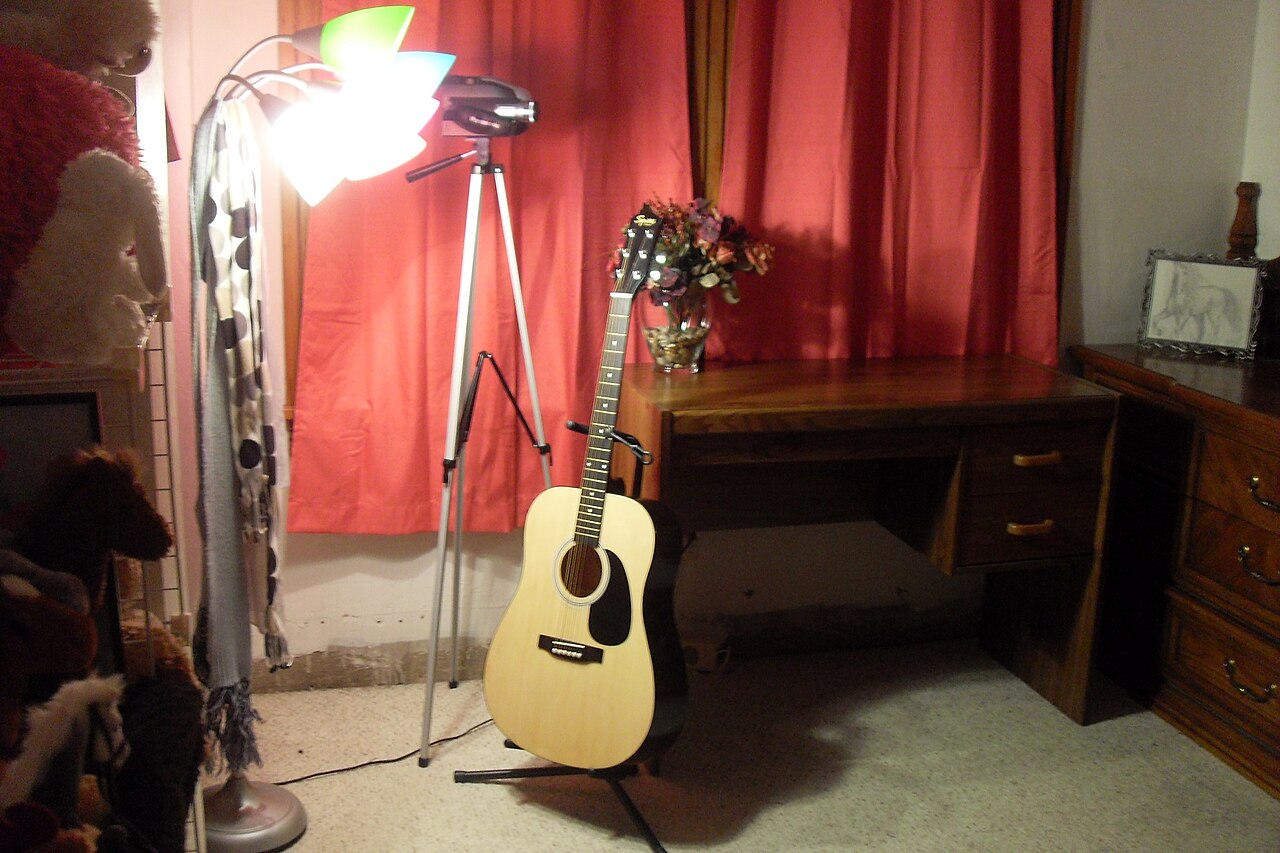
So I bought a cheap guitar stand and set it up next to my desk. Now the guitar is the first thing I see when I walk into my room after work. It's right there within reach, and starting got a lot easier. My roommate walked past and said, "Nice decoration." "It's not decoration, it's for practice." "Sure. Let's talk again in two months."

Stuck on the F chord for two weeks
In week three I hit the F chord. It's a barre chord, meaning one finger has to hold down all six strings, and no matter how hard I pressed, two or three strings came out dead. I put in my 25 minutes every night for two weeks and couldn't feel any progress at all.
One evening my roommate leaned in the doorway. "Doesn't that sound exactly like yesterday?" "One more string rang out than yesterday." That's what I said. What I was thinking was, 'Did it, though? I honestly can't tell.'
From then on I recorded 30 seconds on my phone every Sunday. Same song, same section. In week four I played the first recording right next to the latest one, and the difference was obvious. I just couldn't hear it day to day. Those 30-second clips are what got me through the plateau.
Two months later, one song for my coworker
Over two months I hit start on roughly 41 weeknights. Team dinners and late nights at the office knocked out most of the rest. More than half the time I did one round and stopped. On good nights I did three. All told it came to just under 60 sessions, less than 25 hours. Not a lot.
But I could play one song I love from start to finish without stopping. I brought the guitar to my coworker's housewarming and played it. "Huh. You actually did it." That stuck with me longer than I expected.
From what I've read, there's a fair amount of research on motor skills suggesting short, frequent practice beats cramming it all into one session. There's no evidence that 25 minutes is the magic number, though. For me, 25 minutes was just a size I could believe I'd manage even after a long day. For someone else, 15 might be the right fit.
If you have an instrument gathering dust
The difference between three years ago and this time wasn't willpower. I made starting easier, and I made it okay to miss a day as long as I pressed start again the next one. If there's an instrument sitting in a closet somewhere in your place, here's what I'd try.
- Make the goal "press start once," not a number of hours. One round counts.
- Decide what each 25 minutes is for before you begin, so you don't spend it deciding.
- Keep the instrument out where you can see it. Getting it out of a case is a bigger hurdle than it sounds.
- Actually rest your hands during the break. One bad set of blisters can cost you a week.
- When you hit a plateau, record yourself once a week and compare. You can't hear slow progress day to day.